Research Project Investigates Hydrogen Production from Wastewater

The Institute for Social-Ecological Research (ISOE) has launched the reSYNERGY research project. A consortium of water and energy sector organizations will conduct research through March 2029 on how municipal wastewater can be harnessed for the production of green hydrogen. The goal is to achieve a more resilient water and energy supply by 2035.

by | July 16, 2026

Municipal wastewater treatment plant
© pixabay/jarmoluk
Forschungsprojekt untersucht Wasserstoffproduktion aus Abwasser

How can green hydrogen be produced without placing additional strain on water resources? The reSYNERGY research project is investigating this question. Electrolyzers requirehigh-purity water for hydrogen production. Droughts and competing uses place a strain on available water resources. That is why ISOE is investigating how treated municipal wastewater can serve as an alternative water resource for hydrogen production. The project aims to more closely integrate existing water and energy infrastructures, thereby increasing supply security by 2035.

The project partners have developed a demonstration plant that treats municipal wastewater to produce ultrapure water. The ultrapure water is then used as a feedstock for hydrogen production. The project is investigating the technical feasibility, economic viability, and operational safety of the process. Simulations are also being used to analyze the resilience of large-scale infrastructure to extreme weather events and system disruptions.

Models for Cross-Sector Collaboration

In this project, the researchers are examining not only technical issues but also institutional and societal frameworks. They also aim to develop governance models for collaboration between the water sector, the energy sector, industry, and local governments. Participatory processes involve relevant stakeholders and are intended to ensure acceptance, feasibility, and long-term prospects for transformation.

The ISOE coordinates the research consortium. The institute contributes its expertise in socio-ecological water research and the analysis of interconnected infrastructures. Together with the project partners, it develops future scenarios for the water and hydrogen sectors. Based on these scenarios, the institute derives recommendations for policy and planning actions.

The Federal Ministry of Research, Technology, and Space (BMFTR) is funding the project as part of the “Research for Civil Security” funding initiative. The full project title is “Cross-Sectoral Use of Municipal Wastewater for the Production of Green Hydrogen to Strengthen Security of Supply by 2035 (reSYNERGY).”


(Source: ISOE/2026)

Image source, unless indicated in the image above:

Subscribe to the newsletter now

Fuel for your knowledge, delivered to your inbox every week.

Sign up here

H2 Projects in Your Region

More than 300 hydrogen projects in Germany and Europe

Click here for the interactive map

Siemens digitalisiert 100-MW-Wasserstoffanlage in Portugal

Der Technologiekonzern Siemens AG digitalisiert die geplante 100-MW-Anlage „GalpH2Park“ des Energieunternehmens Galp Energia SGPS S.A. im portugiesischen Sines. Mithilfe eines digitalen Prozesszwillings soll die Hydrogen Performance Suite (HPS) die Produktionsplanung und den Energieeinkauf optimieren. Laut Siemens sind dadurch Energieeinsparungen von bis zu 15 Prozent möglich. Nach eigenen Angaben wird die Anlage eine der größten Anlagen für erneuerbaren Wasserstoff in Europa sein.

Read more
Tesa bezieht Wasserstoff von EWE aus Emden

Der Energieversorger EWE AG und der Klebeband-Hersteller Tesa SE haben Anfang Oktober einen Liefervertrag über jährlich 500 Tonnen erneuerbaren Wasserstoff unterzeichnet. Ab 2028 soll der H2 aus Emden das Tesa Werk Hamburg versorgen und die CO2-Emissionen dort um rund 6.000 Tonnen pro Jahr senken. Eingesetzt werden soll der Wasserstoff im Werk für die Dampferzeugung.

Read more
„Die technische Machbarkeit ist nachgewiesen, die größte Herausforderung liegt im Markthochlauf“

Vom Abgassystem zur Brennstoffzelle: Purem by Eberspächer bringt seine Erfahrung aus der Akustik- und Abgasreinigungstechnik gezielt in den Wasserstoffbereich ein. Im Interview erklärt Patrick Schaller, Product Director für Wasserstoffanwendungen und -komponenten, wie der De-Hydrator die Dampfbildung an Brennstoffzellenfahrzeugen reduziert und wie der Hydrogen Recirculation Blower (HRB) durch Rezirkulation von Wasserstoff die Effizienz steigert. Beide Technologien haben bereits erste Praxistests bestanden. Ende Oktober präsentiert Purem by Eberspächer beide Lösungen live auf der Hydrogen Technology World Expo in Hamburg.

Read more

H2 Talk

„Die technische Machbarkeit ist nachgewiesen, die größte Herausforderung liegt im Markthochlauf“
„Wir wollen e-Fuels vom teuren Nischenprodukt zu einer wettbewerbsfähigen Lösung entwickeln“
„Der Mittelstand ist das Kraftwerk unserer Wirtschaft"

Publications

Power-to-Gas

Power-to-Gas

Year of publication: 2020

This technical book summarizes the latest knowledge on power-to-gas and presents it in a format tailored for engineers in the energy and gas supply sectors. It covers the entire value chain, from the electricity supplied to hydrogen production and integration...

About the Product

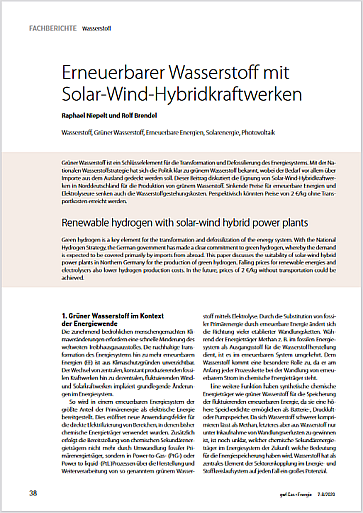
Erneuerbarer Wasserstoff mit Solar-Wind-Hybridkraftwerken

Renewable Hydrogen from Solar-Wind Hybrid Power Plants

Authors: Raphael Niepelt, Rolf Brendel

Green hydrogen is a key element in the transformation and decarbonization of the energy system. With the National Hydrogen Strategy, policymakers have clearly committed to green hydrogen, with demand to be met primarily through imports from ...

About the Product